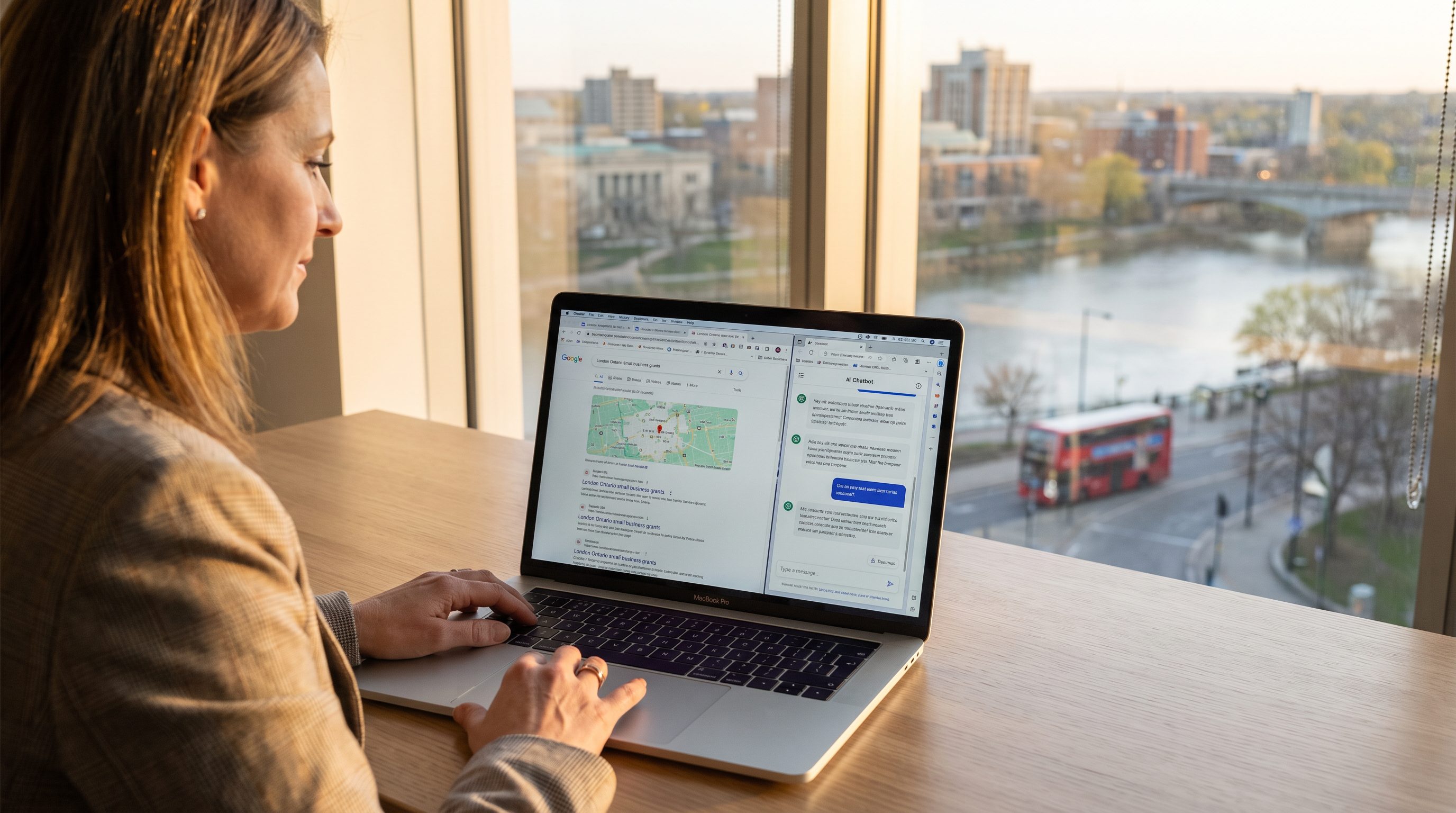
No - Google isn't going away for London, Ontario customers anytime soon, but the search landscape is genuinely shifting, and businesses that ignore that shift entirely are taking on real risk. Here's a grounded answer to the question every London business owner's marketing advisor keeps getting asked: is AI going to make traditional SEO pointless, or is this mostly hype that doesn't require changing anything about how a local business approaches its marketing today?
Why this question keeps coming up
Headlines about ChatGPT's growth and Google's declining share of certain search categories have made their way into mainstream business conversation, and it's a reasonable question for any London business owner to ask their marketing advisor. But headline-level trend coverage rarely distinguishes between different types of search behaviour - informational research versus local transactional intent - and that distinction is exactly what determines how much this trend actually matters for a specific local business.
What's actually true today
Google still handles the overwhelming majority of local, purchase-intent searches in London - "plumber near me," "best dentist London Ontario," "emergency locksmith." These are the searches that drive phone calls and store visits, and Google's Map Pack still captures the large majority of clicks on them. This isn't changing quickly, because immediate, transactional local search is exactly the use case Google has spent two decades optimizing for.
What is changing is where people go for research and recommendations before that final transactional search. A growing share of people - particularly under 45 - now ask ChatGPT, Perplexity, or Google's own AI Mode a question like "who's the best contractor for a kitchen renovation in London Ontario?" before ever typing a traditional Google search. This research layer is where AI search is genuinely displacing some traditional search behaviour today.
Why AI search and Google aren't a zero-sum competition
It's tempting to frame this as AI search "winning" and Google "losing," but the reality is more nuanced. Google itself is deeply invested in AI - AI Overviews and AI Mode are Google's own response to the competitive pressure from ChatGPT and Perplexity, not a separate threat to Google. In practice, Google is absorbing AI-style answers into its own product rather than being purely displaced by outside competitors.
For a London business, this means the practical question isn't "should I optimize for Google or for AI search" - it's "am I building the kind of authoritative, well-structured, trustworthy online presence that performs well across all of these surfaces simultaneously." The underlying signals - genuine expertise, consistent business information, strong reviews, clear content - are rewarded by Google's traditional algorithm, Google's own AI Overviews, and third-party AI systems like ChatGPT and Perplexity, essentially identically.
Where the real risk lies for London businesses
The risk isn't that Google disappears - it's that a business which only optimizes for the old blue-links format misses the growing slice of customers who now do their research through an AI assistant first. If a London roofing company is invisible when someone asks ChatGPT "who's a good roofer in London Ontario," that business has lost consideration before the customer ever opens Google to look for a phone number.
This risk compounds gradually over time rather than appearing suddenly overnight, which makes it easy to underestimate until a competitor has already built a meaningful lead. Each year, a larger share of research-phase local buying decisions will likely involve an AI assistant at some point in the process, even if the final action - calling, booking, visiting - still happens through more traditional channels. Businesses starting to build AI visibility now are positioning for a trend that's very likely to continue growing, even if its exact pace remains genuinely uncertain.
What London businesses should actually do
Rather than picking a side between "invest in Google" or "invest in AI search," the practical path is building a foundation that serves both simultaneously:
- A fully optimized Google Business Profile - still the highest-leverage local visibility investment for the transactional searches that drive immediate revenue
- Consistent business information (NAP) across the web - trusted by both Google's algorithm and AI citation systems
- Genuine review accumulation - a top-weighted signal for Map Pack ranking and increasingly cited by AI systems recommending local businesses
- Structured data (schema markup) - helps both Google's rich results and AI systems understand your business accurately
- Authoritative, well-structured content - answer-first, specific, genuinely useful content ranks in Google and gets cited by AI systems using largely the same underlying quality signals
None of this requires choosing between two competing strategies. It requires doing genuinely good local SEO and content work, which happens to serve both search surfaces at once. A London business that has been executing solid, fundamental local SEO practice for the past year is likely already most of the way toward strong AI search visibility without having explicitly set out to build it - the overlap between the two disciplines is that substantial.
What this looks like across different London business categories
The balance between Google and AI search matters differently depending on what you sell. For urgent, immediate-need services - a burst pipe at 11pm, a locksmith after being locked out - the customer wants the fastest available answer and overwhelmingly still turns to Google's Map Pack, since speed matters more than a curated AI recommendation in that moment. For higher-consideration purchases - choosing a contractor for a major renovation, selecting a family lawyer, picking a dentist for ongoing care - customers increasingly research through an AI assistant first, since the decision feels higher-stakes and they want a pre-filtered shortlist rather than ten unfiltered links to evaluate themselves.
Understanding which category your business falls into helps calibrate priority, though for most London service businesses today, both channels matter enough that neither should be ignored in favour of the other - even an urgent-need business benefits from strong AI visibility for the customers researching in advance rather than in a true emergency.
Why "wait and see" is the riskier choice
Some business owners reasonably ask whether it's worth investing in AI search visibility before the trend is fully proven. The counterargument is that the foundational work - structured data, consistent business information, strong reviews, authoritative content - pays off for traditional Google SEO regardless of how quickly AI search adoption grows. There's very little downside risk to building this foundation now, and meaningful upside if AI search continues its current growth trajectory. Businesses that wait for undeniable proof before acting will be competing from behind against London competitors who started building AI visibility during this earlier, less competitive window.
A realistic 2026-2027 outlook
Expect Google to remain the dominant channel for local, transactional London searches through at least the next several years, while AI search continues to grow steadily as a research and recommendation layer that increasingly influences which businesses get considered before that final Google search or phone call happens. Businesses that invest in both now - rather than waiting to see how the trend fully plays out - are building a durable advantage while most local competitors are still treating this as a hypothetical future concern rather than a present reality worth acting on. Revisit this balance annually rather than trying to predict it precisely; the direction of the trend is clear even if the exact timeline for how quickly AI search grows in local, transactional categories remains genuinely uncertain.
If you'd like a combined assessment of where your London business stands on both traditional Google visibility and AI search readiness, start with a free SEO audit that covers both. Our AI search optimization service and local SEO service are built to work together rather than as competing priorities, since the underlying foundation for both is largely the same body of work.
Related service: AI Search Optimization in London, Ontario →