In 2023, ChatGPT made mainstream headlines. By 2024, Google AI Overviews were appearing at the top of millions of searches. By 2026, the question isn't whether AI search matters - it's how to navigate a world where your content needs to satisfy both a traditional ranking algorithm and an AI system that decides whether to cite you in its generated answers. Here's what actually changed, what stayed the same, and what businesses need to do differently.
What traditional SEO looks like in 2026
Traditional SEO - optimizing for Google's organic blue-link results - hasn't fundamentally changed in its core mechanics. Google still uses:
- Backlinks as a primary authority and trust signal
- On-page relevance signals (title tags, headers, content quality)
- Technical performance signals (Core Web Vitals, mobile friendliness, crawlability)
- User engagement signals (click-through rate, dwell time, pogo-sticking)
- E-E-A-T: Experience, Expertise, Authoritativeness, and Trustworthiness
What's changed in traditional SEO is the competitive threshold. With AI tools making content generation faster and cheaper, there's more mediocre content on the web than ever. Google has responded by elevating its quality bar - shallow, keyword-stuffed content that would have ranked in 2020 is now penalized or ignored. Depth, factual accuracy, and genuine expertise are now table stakes, not differentiators.
How AI search works differently
AI search systems - ChatGPT with web browsing, Perplexity, Google AI Overviews, Microsoft Copilot - work on a fundamentally different model than traditional search:
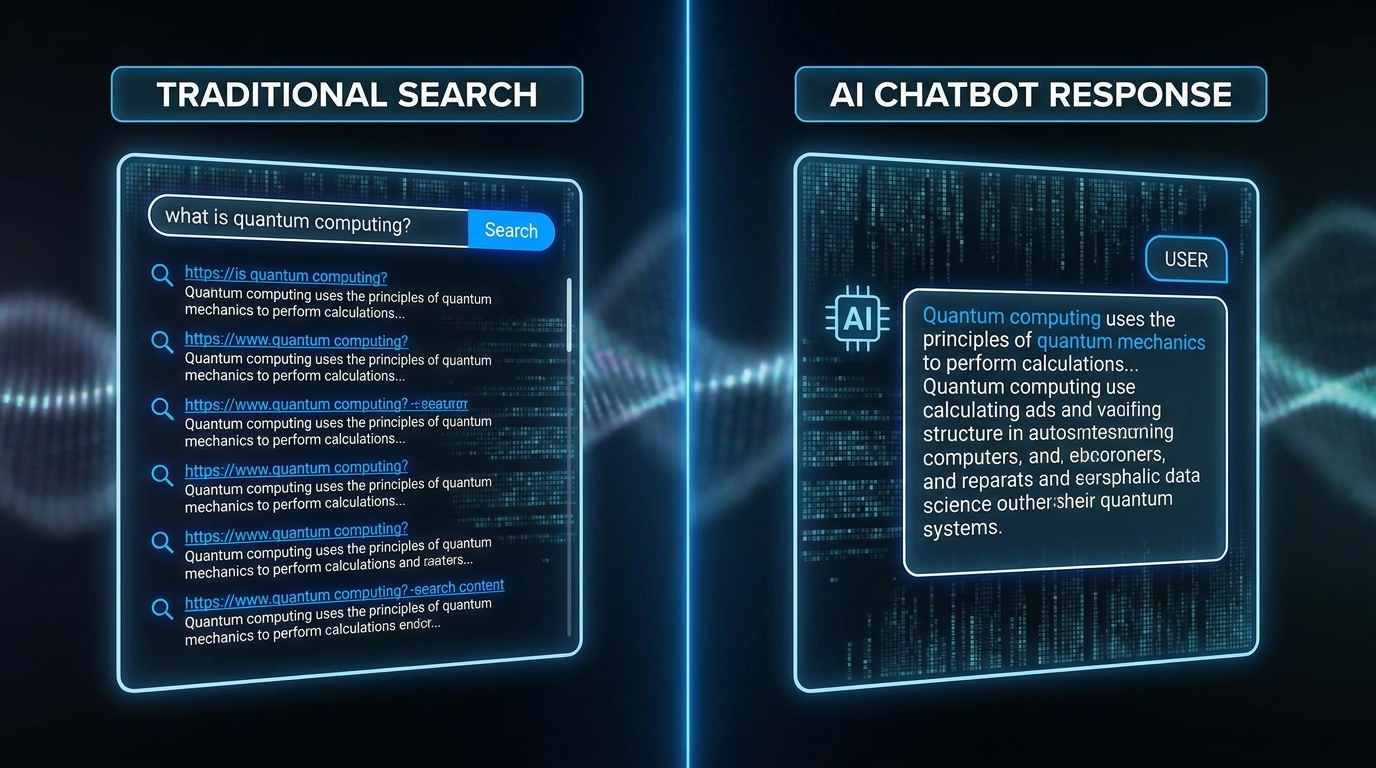
Traditional search: match and rank
Google matches your query against its index, ranks pages by relevance and authority, and returns a list of links. The reader decides which source to visit and evaluates credibility themselves.
AI search: synthesize and cite
AI systems read multiple sources, synthesize information into a direct answer, and cite 2-5 sources that were most authoritative and useful for that answer. The AI makes the credibility judgment, not the reader. Your content either gets cited - with traffic and brand exposure - or it doesn't appear in the answer at all.
This is why AI search changes the stakes for content quality: being #4 in traditional search still gets some traffic. Being the #4 source that an AI considered but didn't cite gets you nothing.
What AI search systems look for in a citable source
Based on observable citation patterns across ChatGPT, Perplexity, and Google AI Overviews, AI systems consistently prefer sources that:
Answer the question directly and early
AI systems are looking for the most direct answer to the query. Content that buries the answer after three paragraphs of preamble is less likely to be cited than content that answers in the opening sentence. Answer-first writing - put your clearest, most direct answer at the top, then explain and expand - is the most reliably effective structural pattern for AI citation.
Come from domains with established topical authority
AI systems weight domain authority heavily. A single excellent article on a domain that's never published on the topic before is less likely to be cited than a good article on a domain that consistently covers that topic with depth and accuracy. Building topical authority - a body of content that demonstrates consistent expertise across a subject area - is foundational for AI citation, just as it is for traditional SEO.
Include specific, verifiable facts
AI systems prefer content that includes checkable claims: statistics, named experts, specific methodologies, concrete examples. Generic advisory content ("there are many factors to consider") is almost never cited. Specific, substantiated content ("according to X study, Y businesses see Z improvement when...") signals the kind of authoritative sourcing that AI systems are designed to surface.
Use structured, scannable formatting
Clear H2/H3 headers, bullet lists for multi-part answers, and concise paragraphs make it easier for AI systems to extract relevant passages. Long walls of undifferentiated text are harder to parse and cite accurately than well-structured content where each section addresses a specific sub-question.
What's the same across traditional SEO and AI search
Despite the different mechanics, the underlying requirements overlap significantly:
- Content quality: Both reward genuine expertise, factual accuracy, and depth. Neither rewards keyword-stuffed or shallow content.
- Domain authority: Both weight the reputation and authority of the publishing domain. Backlinks and brand mentions remain important signals.
- Technical accessibility: Both require your content to be crawlable and indexable. A site blocking AI crawlers (PerplexityBot, GPTBot) can't be cited, just as a site blocking Googlebot can't rank.
- Structured data: Schema markup helps both traditional Google and AI systems understand your content's entities, relationships, and credibility signals.
This convergence is the practical opportunity: optimizing for AI citation tends to improve traditional SEO as a side effect. Businesses that invest in high-quality, well-structured, authoritative content are building an asset that performs across all search surfaces simultaneously.
What to do differently for AI search
Check that AI crawlers can access your site
Review your robots.txt file and verify that GPTBot, PerplexityBot, ClaudeBot, and Googlebot-Extended are not blocked. These are the primary crawlers for major AI search systems. If you've added blanket bot-blocking rules, you may be preventing AI systems from ever reading your content.
Build author and expert profiles
AI systems have a preference for content attributed to named, verifiable authors with expertise in the topic. Anonymous content or "Staff Writer" bylines are at a disadvantage. Creating detailed author bio pages - listing credentials, areas of expertise, and professional history - builds the E-E-A-T signals that influence both AI citation and traditional ranking.
Create a dedicated AI-optimized content format
Concise, direct, well-structured articles in the 800-1,500 word range - that comprehensively answer one specific question - are among the most consistently cited content types. These are different from the 3,000+ word pillar pages that dominated traditional SEO strategy. Both have a role, but short, focused answer articles are particularly effective for AI citation.
Monitor your AI visibility
Track whether your brand and content appear in AI-generated responses for your key queries. Search your target terms in ChatGPT, Perplexity, and check Google AI Overviews. This tells you which competitors are being cited and what content types are driving those citations - giving you a content strategy roadmap.
Our AI search optimization service helps London businesses build visibility across both traditional search and AI platforms. Start with a free SEO audit that includes an AI visibility assessment.
Related service: AI Search Optimization in London, Ontario →